
GFRP rebar is becoming an important topic in modern construction as builders and engineers explore alternatives to conventional steel reinforcement. Known for its lightweight structure and corrosion resistance, Glass Fiber Reinforced Polymer (GFRP) rebar offers specific advantages for concrete structures when selected and designed correctly.
For Indian construction professionals, understanding what GFRP rebar is, its properties, available types and common applications can help in making informed material decisions.
What Is GFRP Rebar?
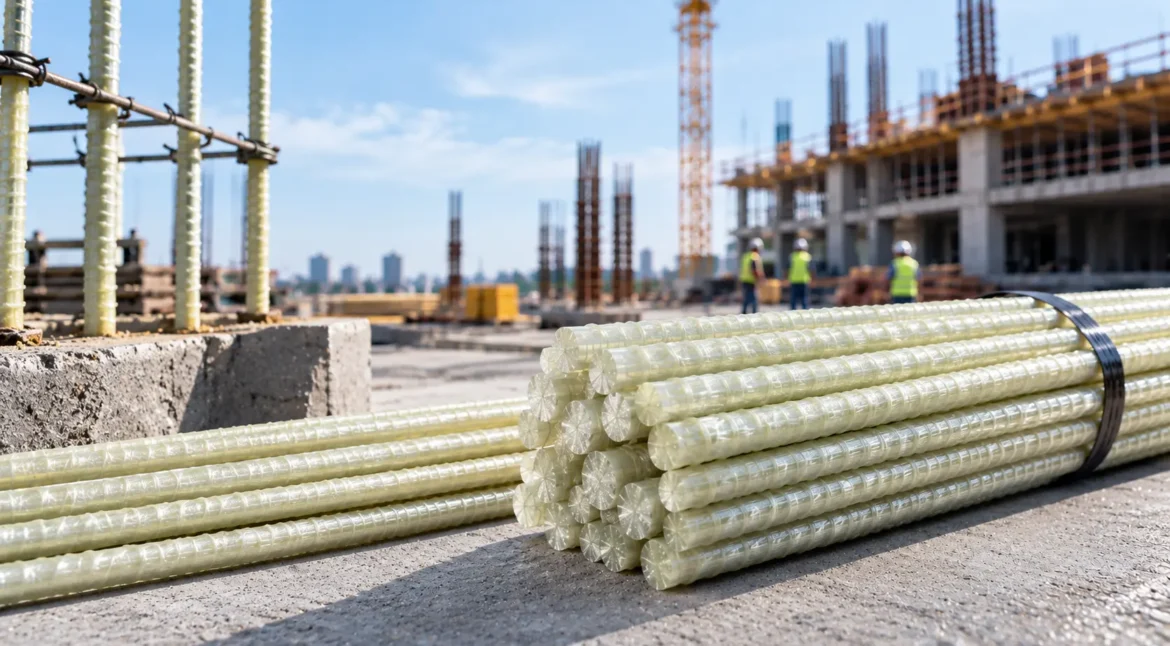
GFRP rebar stands for Glass Fiber Reinforced Polymer rebar. It is a composite reinforcement bar made using glass fibres combined with a polymer resin. The glass fibres provide tensile strength, while the resin holds the fibres together and forms the finished bar.
Like steel rebar, GFRP rebar is used to reinforce concrete. However, its material behaviour is different. It does not rust like steel, is lightweight and is non-magnetic. These characteristics make it suitable for selected residential, commercial, industrial and infrastructure projects.
GFRP rebar should not be treated as a direct replacement for steel in every structure. Its suitability depends on structural design, loading conditions and project requirements.
Key Properties of GFRP Rebar
Understanding GFRP rebar properties helps engineers and contractors decide where it may be appropriate.
1. Corrosion Resistance
One of the main benefits of GFRP rebar is its resistance to conventional steel corrosion. It can be useful in concrete structures exposed to moisture, chlorides and certain aggressive environments, provided the product is suitable for the specific exposure conditions.
2. Lightweight Construction Material
GFRP rebar is considerably lighter than steel reinforcement of comparable size. This can make transportation, handling and placement easier on construction sites. Proper storage and installation are still necessary to avoid damaging the bars.
3. High Tensile Strength
GFRP rebar can offer high tensile strength, depending on its fibre composition, resin system, diameter and manufacturing quality. However, it generally has a lower elastic modulus than steel and does not yield in the same way. Engineers must account for these differences during structural design.
4. Non-Magnetic Properties
Since GFRP rebar is non-metallic, it is non-magnetic and electrically non-conductive. These characteristics can be useful in specialised facilities where magnetic interference or electrical conductivity is a concern.
Types of GFRP Rebar
GFRP rebar can be classified according to its surface profile, manufacturing characteristics and intended application.
1. Sand-Coated GFRP Rebar
Sand-coated bars have a textured surface intended to improve bonding with concrete. The actual bond performance depends on the surface treatment and product specifications.
2. Ribbed or Deformed GFRP Rebar
These bars feature a raised or textured external profile designed to provide mechanical interlock with concrete. The geometry and performance should be verified through product documentation and testing.
3. Different Diameters and Bar Forms
GFRP rebar is available in different sizes and may be supplied in straight lengths or specified bent shapes, depending on the manufacturer and product standard. Not every bar can be bent on site; follow the manufacturer’s instructions and approved detailing.
Common Applications of GFRP Rebar
GFRP rebar can be considered for various concrete reinforcement applications where its properties match the project requirements.
- Residential construction: Selected slabs, foundations and other designed concrete elements.
- Commercial buildings: Concrete components in offices, retail buildings and commercial developments.
- Industrial projects: Structures where corrosion resistance is an important consideration.
- Roads and pavements: Selected concrete pavement and infrastructure applications.
- Water and wastewater facilities: Suitable tanks and treatment structures, subject to exposure and design requirements.
- Specialised facilities: Projects requiring non-magnetic or electrically non-conductive reinforcement.
The final application should always be approved by a qualified structural engineer.
GFRP Rebar vs Steel Rebar
The main difference between GFRP and steel rebar is their material behaviour. Steel is ductile and has a higher elastic modulus, while GFRP is lighter and resistant to conventional corrosion but behaves as a linear-elastic material until failure. GFRP reinforcement therefore requires specific design calculations for strength, deflection, cracking and detailing.
The choice should consider more than the initial material price. Project conditions, installation requirements, expected service life and applicable design standards also matter.
Why Choose MaxFibar for GFRP Rebar?
MaxFibar, a brand of Mangla Infraprojects LLP, provides GFRP reinforcement solutions for construction professionals exploring alternatives to conventional reinforcement materials.
Whether you are a builder, contractor, civil engineer or developer, checking product specifications and technical documentation is essential before placing an order.
Contact MaxFibar to discuss your GFRP rebar requirements, product information and project-specific needs.
Website: https://maxfibar.com/
Phone: 98775 16571
Frequently Asked Questions
1. What does GFRP rebar stand for?
GFRP stands for Glass Fiber Reinforced Polymer. It is a composite reinforcement bar made from glass fibres and polymer resin.
2. Does GFRP rebar rust?
GFRP rebar does not rust like conventional steel because it is made from glass fibres and polymer resin rather than iron-based metal.
3. Is GFRP rebar stronger than steel?
GFRP can have high tensile strength, but strength alone does not determine structural performance. Its stiffness and failure behaviour differ from steel, so engineers must compare the materials using the requirements of the specific design.
4. Where is GFRP rebar commonly used?
It can be used in selected building components, industrial structures, pavements and other concrete applications where its properties are suitable.
5. What should I check before buying GFRP rebar?
Check bar dimensions, surface profile, test reports, quality-control documentation, traceability and compliance with applicable project specifications. ASTM D7957/D7957M covers specified GFRP reinforcing bars, while ACI CODE-440.11-22 provides design and construction provisions for qualifying GFRP-reinforced concrete.
Explore GFRP Rebar Solutions for Your Project
GFRP rebar offers a useful reinforcement option for projects where lightweight handling and corrosion resistance are priorities. The right choice depends on the structural design, product quality and conditions in which the reinforcement will be used.
Looking for a GFRP rebar manufacturer or supplier in India? Contact MaxFibar to discuss your construction requirements and explore suitable reinforcement solutions.