

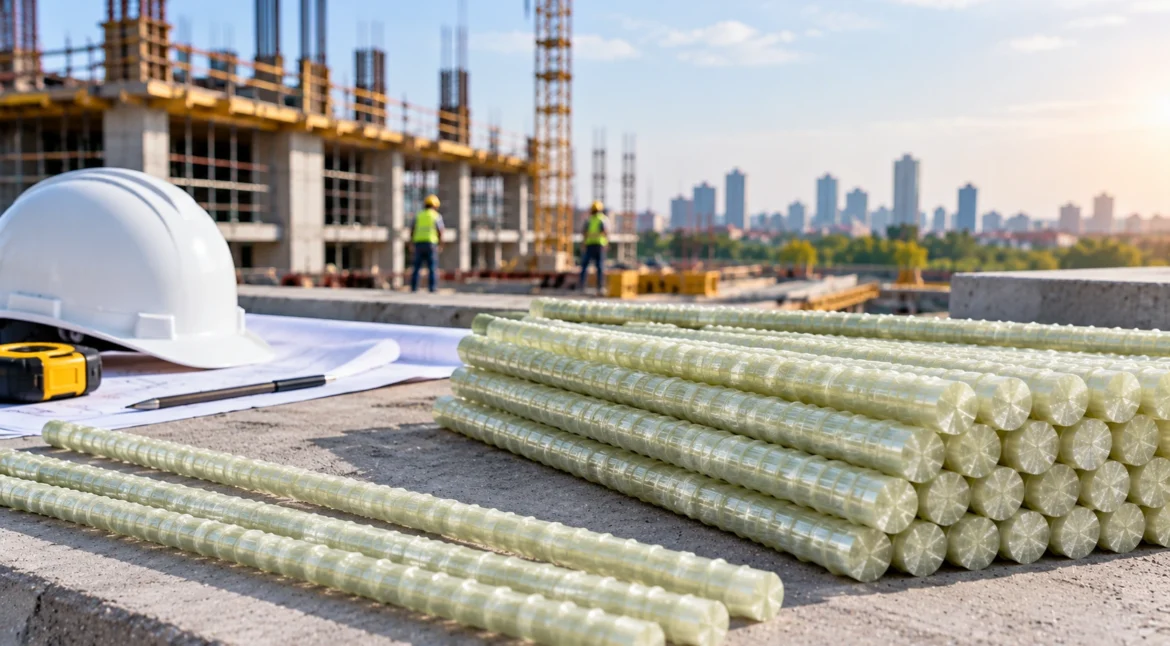
Glass Fiber Reinforced Polymer (GFRP) rebar is gaining attention in the construction industry as an alternative to conventional steel reinforcement. With its lightweight structure and corrosion-resistant properties, GFRP rebar can be considered for concrete projects where durability, material handling and long-term performance are important.
For Indian builders, contractors, civil engineers and developers, understanding Glass Fiber Reinforced Polymer rebar properties, applications and design requirements is essential before selecting it for a project.
What Is Glass Fiber Reinforced Polymer (GFRP) Rebar?
GFRP rebar is a composite reinforcement bar made primarily from glass fibres embedded in a polymer resin. The fibres provide tensile strength, while the resin binds the material together and protects the reinforcement.
Unlike steel rebar, GFRP does not rust in the conventional way. It is also non-magnetic and electrically non-conductive, making it suitable for certain specialised construction applications.
As construction projects increasingly consider alternative reinforcement materials, GFRP rebar offers another option for engineers evaluating performance, durability and project costs.
Key GFRP Rebar Properties
Understanding the main properties of GFRP rebar helps construction professionals determine whether it is suitable for their requirements.
1. Corrosion Resistance
One of the main advantages of GFRP rebar is its resistance to conventional steel corrosion. This property can be valuable in concrete structures exposed to moisture, chlorides or other aggressive conditions, subject to the product’s performance and the project environment.
2. Lightweight Structure
GFRP rebar is considerably lighter than steel reinforcement of comparable size. This can simplify transportation, handling and placement on construction sites. However, proper storage, handling and installation practices remain important.
3. High Tensile Strength
GFRP rebar can provide high tensile strength, depending on its diameter, fibre content, resin system and manufacturing quality. However, it behaves differently from steel under loading and generally has a lower elastic modulus. Structural calculations must account for these differences.
4. Non-Magnetic and Electrically Non-Conductive
GFRP rebar does not conduct electricity like steel and is non-magnetic. These characteristics can be useful in selected facilities where electromagnetic interference or electrical conductivity needs to be considered.
Applications of GFRP Rebar in Indian Construction
GFRP rebar can be considered for several concrete reinforcement applications, depending on engineering design and applicable requirements.
- Residential buildings: Selected slabs, foundations and other concrete elements designed for GFRP reinforcement.
- Commercial construction: Reinforced concrete components in offices, retail developments and commercial buildings.
- Industrial facilities: Concrete structures where corrosion resistance is an important consideration.
- Water and wastewater structures: Suitable tanks and treatment facilities, subject to chemical exposure and design requirements.
- Roads and infrastructure: Selected concrete pavements, barriers and infrastructure components.
- Specialised facilities: Projects requiring non-magnetic or electrically non-conductive reinforcement.
GFRP rebar is not a direct, one-to-one replacement for steel in every structure. Engineers must assess the intended application, loading, deflection, fire performance, connections and service conditions before specifying it.
GFRP Rebar vs Steel Rebar: What Is the Difference?
The main difference lies in how these materials behave and perform inside concrete. Steel rebar has a higher elastic modulus and ductile behaviour, while GFRP rebar is lightweight, corrosion-resistant and behaves as a linear-elastic material until failure. GFRP also does not yield like conventional reinforcing steel.
As a result, the reinforcement choice should not be based on tensile strength or purchase price alone. Structural performance, design requirements, installation, maintenance and expected service conditions all need consideration.
What Should You Check Before Buying GFRP Rebar?
Before selecting a GFRP rebar manufacturer or supplier in India, check the following:
- Product diameter, surface profile and intended application.
- Test reports for tensile properties, bond strength and other relevant characteristics.
- Manufacturing quality-control procedures and batch traceability.
- Compliance with applicable project specifications and recognised standards.
- Technical support for storage, handling and installation requirements.
ASTM D7957/D7957M specifies requirements and testing for covered GFRP reinforcing bars. ACI CODE-440.11-22 provides design and construction provisions for concrete structures reinforced with qualifying GFRP bars. Engineers should confirm which standards and approvals apply to their particular project.
Why Choose MaxFibar for GFRP Rebar?
MaxFibar, a brand of Mangla Infraprojects LLP, provides GFRP reinforcement solutions for construction professionals exploring alternatives to conventional reinforcement materials.
Whether you are a builder, contractor, civil engineer or project developer, understanding product specifications and application requirements is an important first step. Contact MaxFibar to discuss your GFRP rebar requirements, product information and project-specific needs.
Website: https://fibarplus.com/
Contact: [Insert verified business phone number]
Frequently Asked Questions
1. What is GFRP rebar used for?
GFRP rebar is used to reinforce selected concrete structures, including building components, industrial facilities, pavements and other applications where its properties suit the design requirements.
2. Is GFRP rebar better than steel rebar?
Neither material is automatically better for every project. GFRP offers corrosion resistance and lower weight, while steel has different stiffness and ductility characteristics. The choice depends on structural design and service conditions.
3. Does GFRP rebar rust?
GFRP rebar does not rust like steel because it is made from glass fibres and polymer resin rather than iron-based metal. Its long-term performance still depends on product quality and environmental exposure.
4. Is GFRP rebar suitable for Indian construction?
It can be suitable for selected Indian construction projects when the product, structural design, installation method and applicable requirements are properly evaluated.
5. What standards should be checked when purchasing GFRP rebar?
ASTM D7957/D7957M covers specified GFRP reinforcing bars, while ACI CODE-440.11-22 provides structural design and construction provisions for qualifying GFRP-reinforced concrete. Project-specific requirements and applicable Indian regulations must also be checked.
Explore GFRP Rebar Solutions for Your Next Project
As Indian construction continues to evaluate alternative reinforcement materials, GFRP rebar offers useful properties for applications where corrosion resistance, reduced weight and specialised performance are priorities.
Before making a selection, consult your structural engineer and verify product quality, test documentation and design suitability.
Looking for a GFRP rebar manufacturer or supplier in India? Contact MaxFibar to discuss your construction reinforcement requirements.
1 Comment
GFRP Rebar vs Steel Rebar: 10 Key Differences (2026)
[…] Either way, a qualified structural engineer should approve the final choice. Check ASTM D7957/D7957M for the bars themselves, ACI CODE-440.11-22 for design, and any Indian requirements that apply to your project. For a deeper look at properties, applications and buying checks, read our complete guide to glass fiber reinforced polymer rebar. […]