
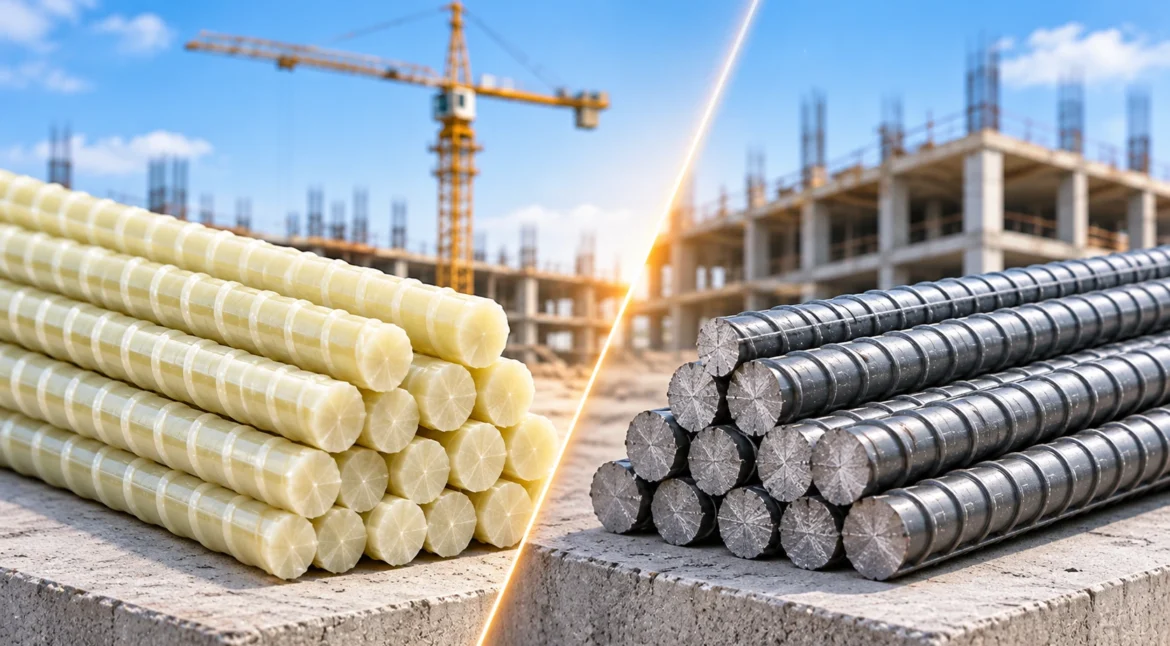
Ask any site engineer what goes into a slab and you’ll hear one word: steel. It has earned that spot. But near the coast, in wastewater plants, or anywhere salt and moisture reach the concrete, steel rusts, swells and cracks its own cover. That’s one reason GFRP rebar India projects are getting more attention from builders, contractors and structural engineers.
But GFRP isn’t simply “steel without the rust.” It behaves differently under load, on site and over the years. Below are 10 differences that matter in real projects.
GFRP vs Steel Rebar: 10 Key Differences
1. What they’re made of
Steel rebar is an iron-carbon alloy, and grades like Fe500D and Fe550D are common in India. GFRP is a composite: glass fibres carry the load, and a polymer resin holds them together. Because GFRP is a manufactured composite, its quality depends heavily on fibre content, the resin system and how well the bars are produced.
2. Weight
For the same size, GFRP is roughly a quarter of the weight of steel. Crews can carry and place it faster, and transport gets simpler. The flip side: light bars need to be tied down properly so they don’t float or shift during the pour.
3. Corrosion resistance
This is the big one. Steel rusts when moisture, oxygen and chlorides reach it, and the rust expands and breaks the concrete around it. GFRP doesn’t rust that way, which makes it a strong corrosion-resistant rebar for marine, wastewater and de-icing salt exposure. You still need good concrete and proper cover, and long-term performance depends on resin quality and the environment.
4. Tensile strength
Along the fibre direction, GFRP can be very strong, but the figure changes with diameter and manufacturer. Always design on the guaranteed strength in the test report, not a typical value from a brochure.
5. Stiffness
GFRP has a much lower elastic modulus than steel, roughly 40 to 60 GPa against about 200 GPa. Put simply, under the same load it stretches more. That’s why deflection and crack width, not strength, often control the design of GFRP-reinforced members.
6. How it fails
Steel yields, so you get visible warning before it fails. GFRP stays linear-elastic until it ruptures, with no yield plateau. Design codes such as ACI CODE-440.11-22 deal with this through their own approach and safety factors, so never swap GFRP into a steel design bar for bar.
7. Bending and fabrication
Steel gets bent on site. GFRP stirrups, hooks and other bent shapes are made at the factory, and the bent portion is generally weaker than the straight length. That means bar schedules and detailing have to be settled early.
8. Electrical and magnetic behaviour
Steel conducts electricity and is magnetic. GFRP is neither. That matters in MRI rooms, certain laboratories, and some power or rail installations where steel simply creates problems.
9. Heat and fire
The resin in GFRP softens as temperature rises, so fire rating and connection details need the designer’s attention. Thermal expansion also differs from steel, so check the manufacturer’s data and the design code.
10. Cost over time
GFRP usually costs more upfront, but price per kilogram is a misleading comparison because the bars are so much lighter. Look at cost per metre installed, handling effort and repair costs over the structure’s life. In harsh environments, avoiding corrosion repairs can change the maths. In mild conditions, steel may stay cheaper.
When to Choose GFRP, and When to Stay With Steel
GFRP is worth a serious look when a structure faces chlorides, moisture or aggressive chemicals, when you want low maintenance over decades, or when the project needs non-magnetic, non-conductive reinforcement. Steel usually fits better when ductility is central to the design, when members need heavy on-site bending, or when conditions are mild and the budget is tight.
Either way, a qualified structural engineer should approve the final choice. Check ASTM D7957/D7957M for the bars themselves, ACI CODE-440.11-22 for design, and any Indian requirements that apply to your project. For a deeper look at properties, applications and buying checks, read our complete guide to glass fiber reinforced polymer rebar.
Frequently Asked Questions
1. What is the main difference between GFRP rebar and steel rebar?
Steel is stiff, ductile and can rust. GFRP is light, doesn’t rust and doesn’t conduct electricity, but it’s less stiff and doesn’t yield before it fails, so it needs its own design approach.
2. Is GFRP rebar stronger than steel?
In the fibre direction, GFRP can have higher tensile strength. But strength isn’t the whole story. Lower stiffness and a different failure mode mean you should compare the two against the actual design requirements.
3. Does GFRP rebar corrode like steel?
No. It doesn’t rust the way iron-based steel does, so it works well as corrosion-resistant rebar. Long-term performance still depends on product quality and the environment it sits in.
4. Can GFRP rebar be bent on site?
Generally no. Stirrups, hooks and other bent shapes are made at the factory. Follow the manufacturer’s instructions and the approved detailing.
5. Is GFRP rebar more expensive than steel?
Often, yes, upfront. But compare cost per metre, handling effort and lifecycle maintenance before deciding, especially for structures in aggressive environments.
Final Thoughts
GFRP and steel aren’t rivals so much as tools for different jobs. Steel is hard to beat in ductile, everyday construction. GFRP earns its place where corrosion, weight or electrical neutrality is the real problem. The right call comes from your exposure conditions, your structural design and the quality of the product you buy.
If you’re weighing GFRP for a project, contact MaxFibar and we’ll talk through your requirements, product specifications and test documentation. MaxFibar is a brand of Mangla Infraprojects LLP.